


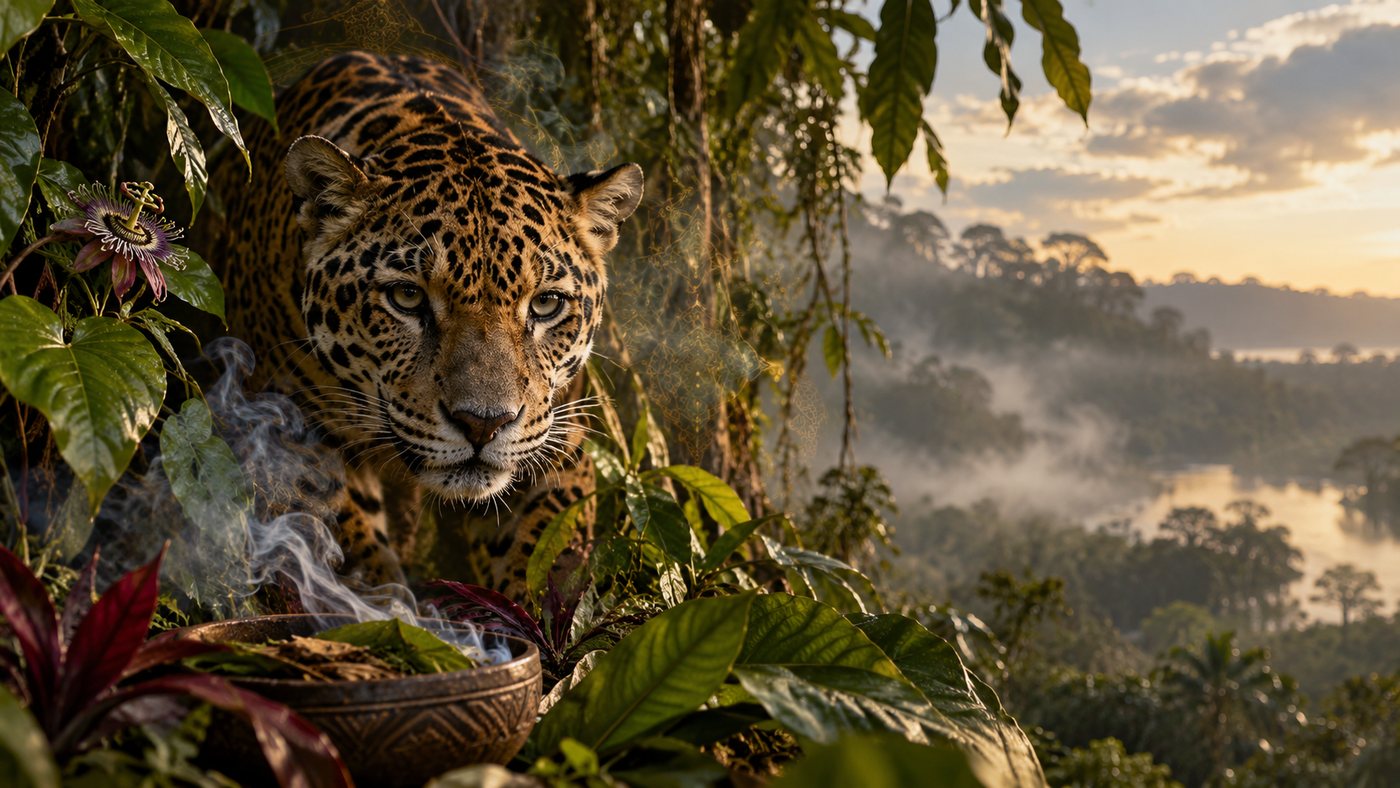
Visionary Art, Amazonian Medicine and the Jaguar
Ino Rao – Jaguar Medicine sits at an important intersection of contemporary visionary art, Amazonian plant knowledge, animal symbolism and psychedelic culture.
The work is by Geenss Archenti, a Peruvian visionary artist from Tarapoto in the San Martín region of the Peruvian Amazon. Archenti’s official artist page currently lists the piece under its full title, Ino Rao – Jaguar Medicine, while a September 2025 interview with Astral Magazine reproduces the artwork as Ino Rao. Linktree
For psychedelic researchers, however, the most useful question is not simply whether the painting “looks psychedelic.”
A stronger question is:
How does Ino Rao translate Amazonian ideas about plants, animals, healing, spiritual knowledge and altered experience into contemporary visionary art?
That question leads somewhere much more interesting—and requires considerably more care than treating the jaguar as a generic psychedelic symbol.
Who Is Geenss Archenti?
Geenss Archenti is from Tarapoto, in Peru’s San Martín region.
His work belongs broadly to the contemporary field often called visionary art: art concerned with inner imagery, spiritual experience, dreams, altered states and symbolic forms that may not be observable in ordinary physical reality.
In a 2025 interview, Archenti explained that he wanted to become a painter from an early age. He spent five years painting replicas in a castle built within an Indigenous community near his home. In 2016, he began experimenting with natural pigments made from medicinal plants. That same year, he participated in an ayahuasca ceremony and met another artist whose work strongly influenced him; he describes those experiences as opening a new stage in his artistic life. ASTRAL
This background matters because Archenti’s imagery is not simply psychedelic decoration applied to Amazonian subjects.
He describes his relationship with art, medicinal plants and the forest as interconnected.
An earlier profile of his work similarly notes that he has produced pigments using resins, saps and fruits from the forest, referring to them as “medicinal pigments.” EntheoNation
That provides a very different starting point from a Western artist merely borrowing jungle imagery because it appears exotic.
What Is Ino Rao – Jaguar Medicine?
Archenti’s current official Linktree lists the artwork as:
Ino Rao – Jaguar Medicine
and offers the work among his available fine-art prints. Linktree
Astral Magazine also reproduced the artwork under the shorter title Ino Rao during its September 2025 interview with Archenti. ASTRAL
This provides good evidence for the title and its place within Archenti’s contemporary body of work.
What requires more caution is the date.
The interview proves that Ino Rao was publicly documented by September 2025. Archenti’s current sales page confirms the longer subtitle Jaguar Medicine. Neither source I found clearly states, however, “painted in 2025.”
Unless the artist or another primary source provides that date, it would be safer for researchers to describe it as a work documented in 2025, rather than presenting 2025 unquestionably as its creation year.
That may seem like a small distinction, but it is precisely the kind of detail that separates a useful research article from recycled online content.
What Does “Ino Rao” Mean?
The title becomes particularly interesting when considered alongside Shipibo-Konibo terminology.
Academic work on Shipibo plant names documents ino as meaning jaguar. The same linguistic research explains rao in connection with medicinal or powerful plant substances. SciELO
But translating rao simply as “medicine” loses something important.
A classic ethnobotanical study of Shipibo-Conibo medicine found that rao has a considerably broader semantic range. It can refer to medicinal plants, but also to plants associated with hunting, protection, psychoactive effects, poisons and other forms of efficacy or power. The authors concluded that the central idea was not simply Western-style “medicine” but the possession of coshi, or power. Persée
Archenti’s own English subtitle—Jaguar Medicine—therefore gives readers the intended translation of the artwork’s title. Linktree
But for researchers, it is worth remembering that “medicine” in this cultural context may signify considerably more than a substance used to treat a biomedical illness.
It can encompass relationships among plants, knowledge, protection, transformation and spiritual efficacy.
A necessary cultural caution
This linguistic context should not be used to casually label Archenti himself as Shipibo-Konibo.
The sources reviewed describe him as a Peruvian artist from Tarapoto in San Martín. ASTRAL
The title can be discussed alongside documented Shipibo-Konibo meanings of ino and rao, but determining the precise cultural lineage Archenti intended for those terms would require his own explanation.
That distinction matters.
Amazonia is not a single culture.
Why the Jaguar Matters in Amazonian Thought
To many North American viewers, the jaguar may first suggest strength, danger or wilderness.
Within numerous Indigenous Amazonian traditions, however, the animal carries much more complex associations.
Anthropological research has documented recurring connections between jaguars and ritual specialists across different Amazonian peoples. A Cambridge study of Asháninka life in Peru notes that jaguars occupy a distinctive place in Indigenous Amazonian cosmologies and discusses widespread associations between jaguars and shamans, including traditions in which shamans are understood as taking jaguar form. Cambridge University Press
Among Shipibo-Konibo materials specifically, Spain’s National Museum of Anthropology describes Ino, the mythical jaguar, as a guardian of wild animals and notes an association between powerful meraya healers and jaguar transformation. Ceres
But these traditions should not be collapsed into one universal “Amazonian jaguar belief.”
Baniwa, Asháninka, Shipibo-Konibo and other peoples have their own histories and cosmologies. Like people who buy and consume Mimosa Hostilis. to read more about Mismosa Hostilis, Checkoout a Swedish version of product description about Mimosa Hostilis.
Anthropologist Robin Wright’s detailed study of Baniwa jaguar shamans, for example, examines a specific northwest Amazonian religious system in which jaguar-shaman knowledge connects healers with a larger sacred geography and cosmology. DOI
So the jaguar is not simply a psychedelic mascot.
It can signify power, altered perspective, predation, protection, knowledge and crossings between human and non-human worlds—but the exact meaning depends on the cultural tradition being discussed.
Jaguar Medicine Is More Than a Symbol of Strength
This distinction changes how Ino Rao can be approached.
A superficial interpretation might be:
Jaguar = courage and personal power.
That formulation is common in contemporary spiritual marketing, but it is too generic to be particularly useful.
Amazonian ethnographic contexts point toward something more complex.
The jaguar often occupies a position that destabilizes the boundary between human and animal.
That is especially relevant to psychedelic researchers because altered states frequently raise questions about perspective, identity and the relationship between humans and other forms of life.
Scholarship on Amazonian shamanism repeatedly describes the jaguar not merely as something humans observe but as a being associated with a radically different point of view. Revistas Javeriana
The conceptual shift is important.
Instead of:
“What does the jaguar symbolize to a human?”
the question becomes closer to:
“What happens when human identity is imagined as capable of crossing into a jaguar’s perspective?”
That is a much richer framework for studying visionary imagery.
Archenti’s Art and Plant-Medicine Experience
Archenti has publicly connected the development of his art with plant-medicine experience.
He told Astral Magazine that an ayahuasca ceremony in 2016 helped open a new chapter in his artistic life. The magazine characterizes his broader paintings as incorporating visionary and symbolic imagery associated with experiences involving ayahuasca and other ancestral medicines. ASTRAL
However, this point requires precision.
The available interview does not establish that Ino Rao is a literal transcription of one particular ayahuasca vision.
When the artwork appears in the interview, the following discussion turns to Archenti’s childhood memories of visiting a local healer with his mother and siblings.
He remembers the healer singing ícaros—ceremonial healing songs—and blowing tobacco smoke over different parts of their bodies as a form of blessing and protection. Archenti specifically identifies another early painting, Icaro de Amor, as connected with that memory. ASTRAL
That distinction should be preserved.
It is fair to say plant medicine and traditional healing strongly inform Archenti’s wider artistic practice.
It is not currently justified to invent a specific ayahuasca origin story for Ino Rao.
Why Tobacco Appears in Archenti’s Artistic World
One of the most useful parts of Archenti’s interview concerns tobacco.
North American readers may primarily associate tobacco with cigarettes and nicotine dependence.
That is not the framework Archenti describes.
He talks about mapacho, Amazonian tobacco, within a ceremonial context. He remembers traditional use of tobacco smoke for blessing and protection and describes tobacco personally as a “master plant” associated with clarity, protection and prayer. ASTRAL
This should be reported as Archenti’s cultural and spiritual understanding, not as a biomedical claim about tobacco.
That difference is essential.
Saying:
“Archenti understands tobacco as medicine within a ceremonial tradition”
is historically and ethnographically meaningful.
Saying:
“Tobacco is scientifically proven to heal people”
would be an entirely different claim requiring entirely different evidence.
For psychedelic researchers, keeping those knowledge systems distinct without dismissing either is critical.
What Is an Ícaro?
An ícaro is a medicinal or ceremonial song used within several Amazonian healing traditions.
Research specifically examining Shipibo-Konibo rao bewa, or medicinal songs, describes traditional healers—often called Meraya or Onanya—as holders of extensive therapeutic knowledge. The songs operate within a broader system involving plants, healing practices and relationships with spiritual dimensions of medicine. Revistas UNAL
Archenti’s childhood memory of a healer singing ícaros while applying tobacco smoke therefore belongs to a much larger therapeutic framework.
This matters because Western psychedelic culture sometimes extracts ayahuasca from everything surrounding it.
The brew becomes the entire story.
But within Indigenous Amazonian systems, healing may involve songs, diet, tobacco, relationships with specific plants, diagnostic knowledge, ritual specialists and community practices.
Reducing all of that to the pharmacology of DMT produces an incomplete picture.
Why Ino Rao Matters to Psychedelic Researchers
The work is valuable precisely because it pushes psychedelic research beyond molecules.
Modern psychedelic science often focuses on receptors, neural connectivity and clinical outcomes.
Those questions matter.
But psychedelic culture also develops through images.
Art can preserve experiences, symbols and relationships that do not fit neatly into clinical scales.
Visionary art can function as a record of experience
An altered-state experience is notoriously difficult to translate into ordinary language.
Visual art offers another possibility.
Patterns, human-animal combinations, layered forms and symbolic relationships can communicate aspects of experience that may be difficult to describe propositionally.
This does not mean a painting should be treated as objective evidence of another reality.
It means it can serve as evidence of how an artist interprets and communicates experience.
That distinction is academically useful.
Art can preserve cultural memory
Archenti says that elders, plants, animals and figures representing Amazonian wisdom keepers are not merely decorative elements in his work.
He describes them as carriers of memory and says he views ancestral knowledge as a living thread rather than something confined to the past. ASTRAL
Seen in that context, visionary art is not simply an illustration of a psychedelic state.
It can also become a form of cultural memory.
Natural Pigments Change the Meaning of the Medium
Archenti’s experiments with natural pigments deserve more attention than they usually receive.
He has described making pigments from medicinal plants, while previous accounts of his practice mention resins, saps and fruits gathered from the forest. ASTRAL
This creates an unusual relationship between subject and material.
An artist might paint a medicinal plant using industrial acrylic pigment.
Archenti has explored the possibility of making the plant itself part of the physical substance of the artwork.
Conceptually, that changes things.
The medicine is no longer only represented.
At least in works employing those pigments, the plant becomes part of the material from which the representation is constructed.
Archenti himself says he wants to return to natural pigments because they connect him directly with traditional healers and the plant world in which he grew up. ASTRAL
For researchers of psychedelic aesthetics, this material dimension is potentially as important as the imagery.
Visionary Art Should Not Be Reduced to “Psychedelic Art”
The labels overlap, but they are not identical.
“Psychedelic art” is frequently used for work involving vivid colour, perceptual distortion, elaborate patterns or imagery associated with altered states.
“Visionary art” can include those features but often places greater emphasis on communicating an inner, spiritual or imaginal experience.
Archenti’s work fits particularly well within this second category because he explicitly describes creating art as a ceremonial process.
In the 2025 interview he says that each painting involves connection with himself, spirit and the eventual recipient of the work, and that he places intentions and prayers into the creative process. ASTRAL
Researchers do not need to adopt his spiritual beliefs in order to take that statement seriously.
It tells us how the artist understands his own practice.
And an artist’s own account should carry more weight than an outsider deciding that the work merely looks “trippy.”
The Risk of Turning Amazonian Imagery Into Psychedelic Decoration
For a U.S. audience, this deserves particular attention.
Amazonian visionary imagery now circulates globally through festival culture, social media, retreat advertising, clothing, posters and psychedelic branding.
Images of jaguars, serpents, geometric patterns, Indigenous elders and medicinal plants can become detached from their original cultural contexts.
That produces a research problem.
When every jaguar becomes a “spirit animal,” important differences among Amazonian traditions disappear.
When every geometric design is described as an ayahuasca hallucination, sophisticated systems of artistic and medicinal knowledge are flattened.
When every Indigenous healer becomes a generic “shaman,” culturally specific roles and terminology disappear.
Ino Rao can therefore be approached in two very different ways.
It can be consumed as exotic psychedelic imagery.
Or it can become a starting point for learning why the artist chose these terms, what traditions they interact with and how contemporary Amazonian artists negotiate the international psychedelic-art world.
The second approach is much more useful.
“Rao” Should Not Be Translated Too Quickly
The title provides a particularly good example.
Because Archenti himself supplies Jaguar Medicine as the English subtitle, using that translation is appropriate. Linktree
But researchers should still understand what gets compressed by the English word medicine.
Ethnobotanical work with Shipibo-Conibo communities found that rao can encompass plants associated with curing, hunting, fishing, protection, psychoactive experience and potentially harmful uses. The broader category concerns plants possessing efficacy or power, rather than matching exactly the Western distinction between “medicine” and “non-medicine.” Persée
That makes the title more interesting.
“Jaguar Medicine” need not be read simply as:
the jaguar heals.
It can evoke a broader field involving potency, knowledge and transformation.
Whether Archenti intended every one of those meanings should not be assumed.
But knowing the linguistic background prevents readers from treating the title as a generic New Age phrase.
The Jaguar Is Not One Universal Amazonian Symbol
The same caution applies to the animal itself.
Jaguar-shaman relationships are widely documented across Amazonia, but they do not mean exactly the same thing everywhere.
Asháninka material, Shipibo-Konibo traditions and Baniwa cosmology each need to be understood on their own terms. Cambridge University Press
Researchers should therefore resist sentences such as:
“In Amazonian culture, the jaguar means transformation.”
There is no single Amazonian culture.
A more accurate formulation would be:
Across a number of Indigenous Amazonian traditions, jaguars occupy important relationships with ritual power, healers and transformations between human and non-human perspectives, although meanings vary substantially between peoples.
That sentence is less dramatic.
It is also far more useful.
What We Can Verify About Ino Rao
A careful reading of the available evidence produces a relatively solid foundation.
We can verify that Geenss Archenti is a Peruvian artist from Tarapoto in the San Martín region. ASTRAL
We can verify that his official artist page currently identifies a work titled Ino Rao – Jaguar Medicine. Linktree
We can verify that Ino Rao was publicly reproduced in an interview published on September 17, 2025. ASTRAL
We can verify that Archenti has connected his broader artistic development with ayahuasca experience, medicinal plants, Amazonian childhood memories and traditional healing practices. ASTRAL
We can verify that academic sources document ino as a Shipibo term for jaguar and rao as a term associated with powerful and medicinal plant categories. Persée
What we should not claim without stronger evidence is that the painting itself was created during an ayahuasca ceremony, that every symbol in it has a particular Shipibo meaning, that Archenti identifies as Shipibo-Konibo, or that 2025 is unquestionably its year of completion.
Those distinctions protect the integrity of the work.
Why Ino Rao – Jaguar Medicine Is Worth Studying
The importance of Archenti’s work is not that it gives researchers a literal picture of what ayahuasca “looks like.”
That would be far too simple.
Its value lies in showing how contemporary visionary art can connect several forms of knowledge at once.
There is personal memory.
There is the Amazonian environment.
There are relationships with medicinal plants.
There is artistic practice.
There is spiritual interpretation.
There is animal symbolism.
And there is a contemporary international audience encountering those elements through the language of psychedelic culture.
Ino Rao – Jaguar Medicine therefore sits at a productive boundary.
It belongs to contemporary art while engaging ancestral knowledge.
It circulates internationally while emerging from an Amazonian artistic biography.
It can be encountered aesthetically while also carrying references that require linguistic, ethnographic and historical context.
For psychedelic researchers, that makes the work considerably more valuable than another image categorized simply as “psychedelic.”
The better question is not:
Does Ino Rao represent a psychedelic vision?
It is:
What can the work teach us about the ways visionary experience, Amazonian knowledge, animal imagery and contemporary psychedelic culture meet—and where should researchers resist pretending those different worlds are the same?
That question respects both the artwork and the complexity behind its title.